This website uses cookies to ensure you get the best experience on our website. Learn more

The LAG-R framework (Laboratory Animal Genetic Reporting) is a set of guidelines to support more complete documentation of the genetic make-up of animals of all species that are used in research, with the aim of bolstering reproducibility, reliability, and overall scientific rigour.

Mini colloque CELPHEDIA en webinaire
Les participants à ce mini-colloque se verront délivrer une attestation de présence qui pourrait servir pour valider des heures de formation continue réglementaire.
Une synthèse des outils qu’ils soient objectifs ou subjectifs, disponibles ou en cours de développement, pour l’identification et l’évaluation de la douleur, sera présentée par des orateurs experts dans ce domaine.
L’objectif est également de comprendre les mécanismes physiologiques entrainant la douleur et les réactions de défense de l’animal, ainsi que les mécanismes de sensibilisation centrale chez les modèles animaux mimant des pathologies humaines. Avec pour priorité le respect du bien-être animal, ce colloque ne serait pas complet sans évoquer le point limite qui est le moment où la souffrance d’un animal doit être minimisée ou arrêtée par l’application de divers processus.
Ce colloque est ouvert à toutes les personnes utilisant et/ou manipulant des animaux à des fins scientifiques.
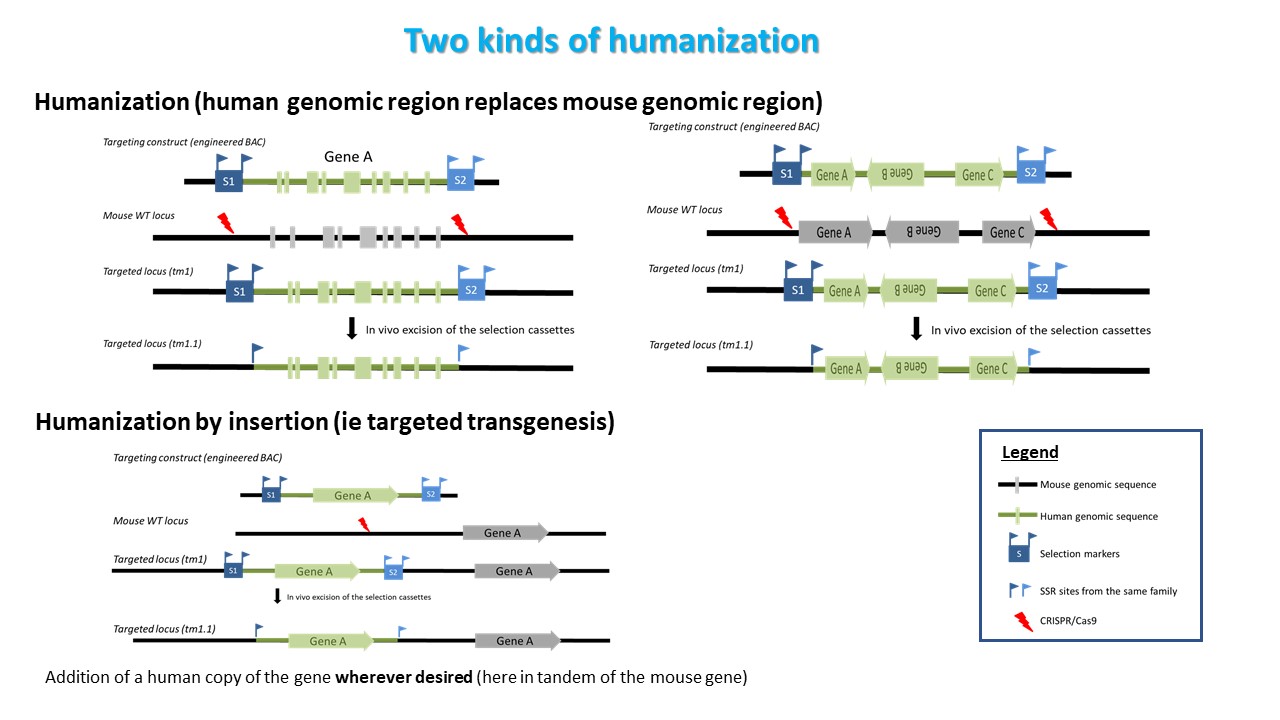
We have successfully validated a method enabling the precise replacement of a mouse gene with its human (or any other species) counterpart. Diverging from prevailing platforms that insert the human fragment (usually as cDNA) into an open chromatin region such as Rosa26 or H11 locus or in the gene of interest, our approach stands out by allowing for the precise targeting of the mouse genome. This distinctive strategy not only achieves genuine humanization of the gene but also holds the distinct advantage of simultaneously knocking out the mouse gene.
Such models allow the expression of all human isoforms and all human introns will be present.
Our approach integrates a unique, in-house-derived ES cell line combined with advanced CRISPR/Cas9 technology.
To sum up:
•Entire gene replacement are now easily achievable
•Entire gene insertion is a powerful alternative to classical Rosa26 locus knockin approaches. Our approach allows insertion of a entire gene in any locus including if course in “safe harbor” locus like Rosa26 locus.
•Our strong expertise in BAC manipulation allows us not only to completely replace/insert a gene, but also to propose any additional mutations, i.e. 2-in-1 or 3-in-1 models, such as designing specific pathological variants or conditional potential by inserting loxP sequences, for example.
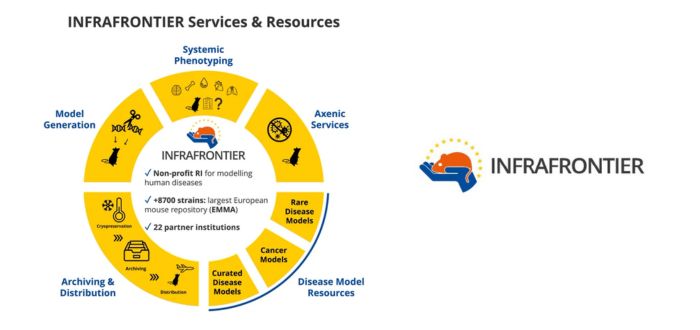
iCS-MCI, is proud to continually contribute to the INFRAFRONTIER Services. take a look at our article "INFRAFRONTIER: mouse model resources for modelling human diseases" is now published in Mammalian Genome journal to catch up on the latest services and resources INFRAFRONTIER added to its portfolio

Marie-Christine Birling, Cheffe Associée du Département d'Ingénérie Génétique de l'iCS , est lauréate de l’une des médailles de Cristal 2023 décernée par le CNRS, annonce l’organisme le jeudi 4 mai. Reconnaissant une carrière jalonnée de belles réussites, cette médaille récompense tout particulièrement l’apport de Marie-Christine Birling dans l’adaptation de la technologie CRISPR/Cas9 à l’édition du génome et la production de modèles animaux.
Avec Philippe André, c'est notre deuxième médaille Cristal du CNRS à l'ICS, ce qui démontre la qualité du travail de toutes nos équipes
Good practices in preclinical studies using rodents. ICS has recently published in collaboration with its partner INFRAFRONTIER : Quality Principles in Systemic Phenotyping of genetically altered mouse models.See the publication.